

Reviewed for scientific accuracy by the Alpha Peps Research Team
What Is Ipamorelin?
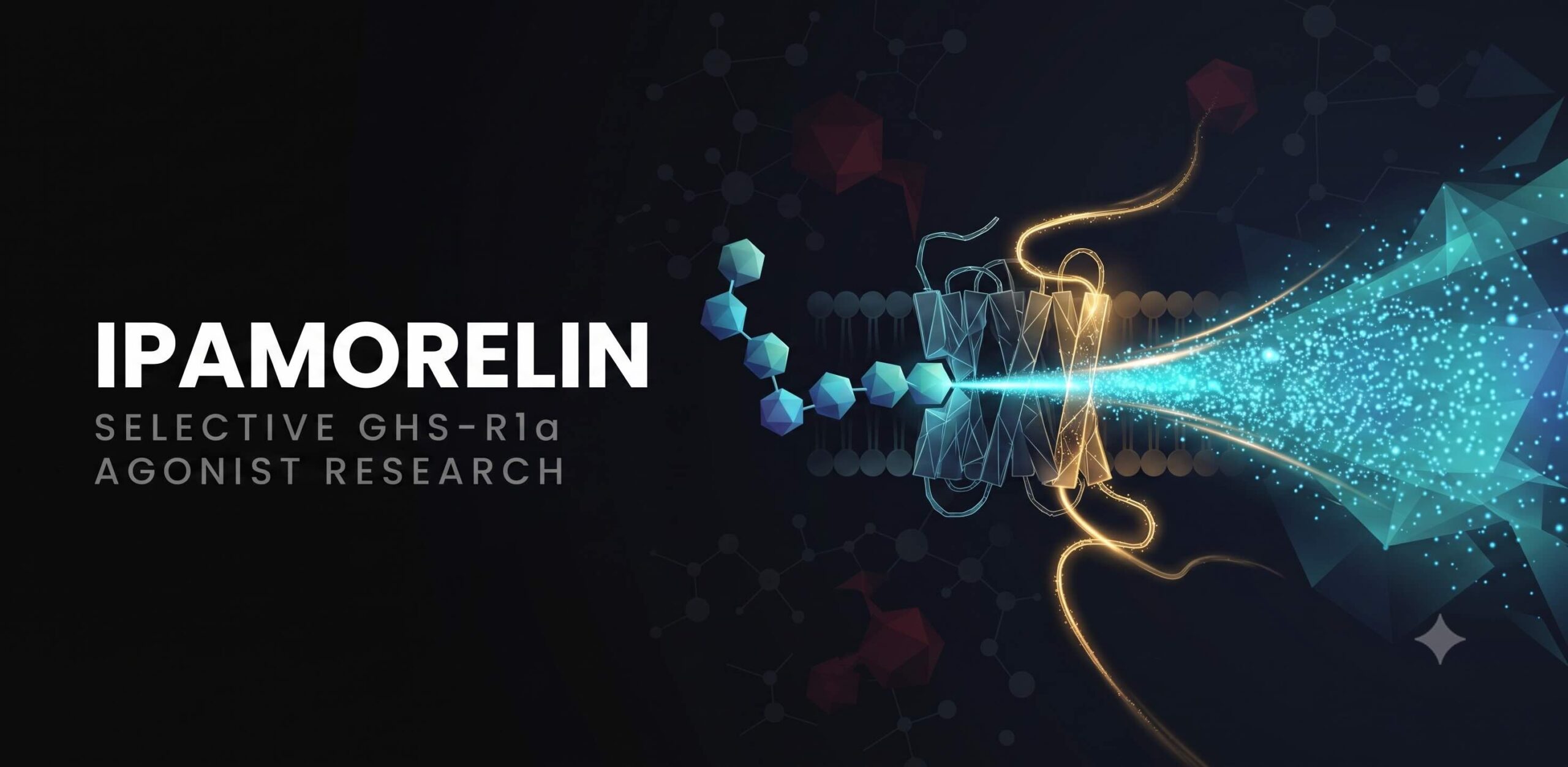
Ipamorelin is a synthetic pentapeptide (Aib-His-D-2-Nal-D-Phe-Lys-NHâ‚‚, molecular weight approximately 711 Da) developed by Novo Nordisk in the late 1990s under the research designation NNC 26-0161. It belongs to a class of compounds known as growth hormone secretagogues (GHS): molecules that stimulate the pituitary gland to release growth hormone by activating the ghrelin receptor, GHS-R1a.
Ipamorelin was first characterized by Raun et al. in 1998, in research that identified it as the first GHRP-class compound to stimulate GH release without producing significant elevations in ACTH, cortisol, or prolactin, a selectivity profile that, until that point, had only been observed with growth hormone-releasing hormone (GHRH) itself.
The Selectivity Problem It Was Built to Solve
Earlier-generation GH secretagogues, GHRP-6 and GHRP-2 in particular, are effective at stimulating GH release, but they do so by activating multiple neuroendocrine pathways simultaneously. Alongside GH, they also trigger measurable increases in ACTH, cortisol, and prolactin. GHRP-6 in particular is a potent appetite stimulant, consistent with its broader activation of ghrelin-pathway signaling beyond the GHS-R1a receptor alone.
For researchers studying the GH axis specifically, this lack of selectivity is a confound. When a compound raises GH alongside cortisol and prolactin, it becomes difficult to isolate which downstream effects are attributable to GH signaling versus the co-secreted hormones.
Ipamorelin’s structure, specifically an α-aminoisobutyric acid (Aib) substitution at position 1 and D-2-naphthylalanine at position 3, confers high binding affinity for GHS-R1a (Ki approximately 1.0–1.5 nM) while substantially reducing affinity for the ACTH/corticotroph pathway and prolactin-stimulating receptors that older GHRPs engage nonselectively.
What the Research Shows
Selectivity is consistent across species and dose ranges. In rat studies, doses producing maximal GH secretion (300 μg/kg IV) showed no statistically significant ACTH increase and no cortisol elevation beyond vehicle control. This pattern holds even at doses exceeding 200-fold the GH-releasing ED50 in animal models. In human studies at 1–2 μg/kg IV, Ipamorelin produced robust GH elevation (peak approximately 2.2 ng/mL) while serum ACTH and cortisol remained within baseline range throughout sampling.
The GH pulse is pharmacologically “cleaner.” Because Ipamorelin’s activity is confined largely to GHS-R1a without the broader receptor engagement seen in GHRP-6 and GHRP-2, researchers describe the resulting GH signal as less confounded by concurrent hormonal changes. This property has made it a preferred tool for isolating GH-specific downstream effects in preclinical models, including research into bone metabolism and longitudinal bone growth.
Research applications span multiple domains. Beyond GH axis biology, Ipamorelin has been studied in models examining bone and connective tissue signaling, gastrointestinal motility, and pituitary somatotroph function.
Human clinical data is limited to a single completed trial. As of April 2026, one peer-reviewed randomized controlled trial of Ipamorelin in humans has been published: a Phase 2 proof-of-concept study by Beck, Sweeney, and McCarter (International Journal of Colorectal Disease, 2014), which investigated Ipamorelin’s effects on postoperative recovery. The trial’s primary endpoint was not met. This is an important distinction: although there is extensive preclinical selectivity data, the human clinical evidence base for Ipamorelin remains narrow.
Studied Alongside CJC-1295
Ipamorelin is frequently studied in combination with CJC-1295, a GHRH receptor analog. The two compounds act on distinct, non-competing receptor pathways: CJC-1295 engages the GHRH receptor to extend the duration of the GH pulse, while Ipamorelin triggers the pulse itself via GHS-R1a. Preclinical research has explored whether this dual-pathway stimulation — engaging both GHS-R1a and the GHRH receptor simultaneously — produces an amplified GH response relative to either compound studied alone.
Regulatory Context
Ipamorelin is not FDA-approved for any human indication. As of September 2023, the FDA classified it as a Category 2 bulk drug substance under Section 503A of the FD&C Act, a designation that prohibits its use in compounded medications for human administration. This classification is independent of and does not affect its status as a research compound sold for laboratory and scientific use.
Frequently Asked Questions
What is Ipamorelin? Ipamorelin is a synthetic pentapeptide and selective growth hormone secretagogue that activates the ghrelin receptor (GHS-R1a) to stimulate pulsatile growth hormone release. It is studied for its high selectivity, producing GH stimulation with minimal effect on cortisol, prolactin, or ACTH, distinguishing it from earlier-generation GH secretagogues.
How does Ipamorelin differ from GHRP-2 and GHRP-6? All three compounds activate GHS-R1a, but GHRP-2 and GHRP-6 also engage additional receptor pathways, producing measurable increases in cortisol, prolactin, and appetite signaling alongside GH release. Ipamorelin’s structure was specifically engineered to minimize these off-target effects, producing a more isolated GH signal.
Has Ipamorelin been tested in humans? One peer-reviewed randomized controlled trial of Ipamorelin in humans has been published (2014), investigating its effects on postoperative recovery. The trial did not meet its primary endpoint. The majority of the published evidence on Ipamorelin’s selectivity profile comes from preclinical animal studies.
Is Ipamorelin FDA-approved? No. Ipamorelin has never received FDA approval for any indication. As of September 2023, it is classified as a Category 2 bulk drug substance, which restricts its use in compounded medications for human administration.
What is Ipamorelin studied alongside in research protocols? Ipamorelin is frequently studied in combination with CJC-1295, a GHRH receptor analog. The two compounds engage separate, non-competing receptor pathways, and their combined effect on GH pulse amplitude and duration is a common area of preclinical investigation.
Alpha Peps Ipamorelin — Research Specifications
Ipamorelin 10mg, and CJC-1295/Ipamorelin 5/5mg for combined research protocols. 99%+ HPLC-verified purity. Batch-specific Certificate of Analysis from Freedom Diagnostics, an independent third-party laboratory, included with every order. Synthesized in the USA.
→ Verify any batch by lot number
→ Shop IpamorelinÂ
For laboratory and research use only. Not intended for human consumption, therapeutic use, or diagnostic application. Nothing in this article constitutes medical advice.
Sources
- Raun, K. et al. “Ipamorelin, the first selective growth hormone secretagogue.” European Journal of Endocrinology, 1998. DOI: 10.1530/eje.0.1390552.
- Beck, D.E., Sweeney, W.B., McCarter, M.D. “Prospective, randomized, controlled, proof-of-concept study of the Ghrelin mimetic ipamorelin for the management of postoperative ileus.” International Journal of Colorectal Disease, 2014. DOI: 10.1007/s00384-014-1898-5.
- FDA. “Bulk Drug Substances Nominated for Use in Compounding Under Section 503A — Category 2.” September 2023.
Related posts
Ipamorelin: The GH Secretagogue Engineered for Selectivity
MOTS-C: The Mitochondrial-Derived Peptide Reshaping Metabolic Research
What Is Sermorelin and Why Does It Have More Human Data Than Most Research Peptides?
Peptide Sciences Shut Down: What Happened and What Researchers Should Know (2026)
Expanding the Horizon of Peptide Therapeutics: How Engineered tRNAs Enable Ribosomal Incorporation of Noncanonical Amino Acids
How Peptide-Based Therapies Like Exenatide Target Insulin Resistance and Inflammation in Type 2 Diabetes
BPC-157 and TB-500: Examining a Dual-Peptide Synergy in Tissue Repair Research
The Role of Tesamorelin in Modulating Growth Hormone Pathways and Metabolism
TB-500: Exploring the Synthetic Analog of Thymosin Beta-4 in Regenerative Research
A Three–Amino Acid Signal in Inflammation Control
IGF-1 LR3: Understanding the Long-Acting Insulin-Like Growth Factor in Research
Human Chorionic Gonadotropin 5000 IU: The Molecular Engine of Reproductive Science
Recent Posts
- Ipamorelin: The GH Secretagogue Engineered for Selectivity
- MOTS-C: The Mitochondrial-Derived Peptide Reshaping Metabolic Research
- What Is Sermorelin and Why Does It Have More Human Data Than Most Research Peptides?
- Peptide Sciences Shut Down: What Happened and What Researchers Should Know (2026)
- Expanding the Horizon of Peptide Therapeutics: How Engineered tRNAs Enable Ribosomal Incorporation of Noncanonical Amino Acids