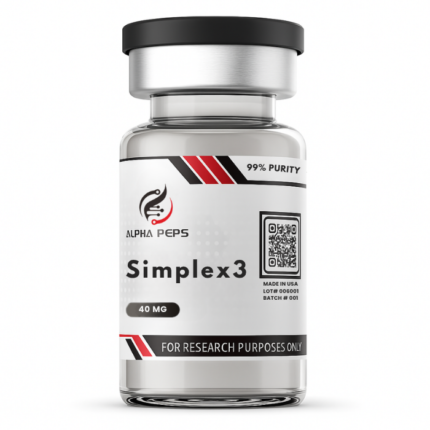


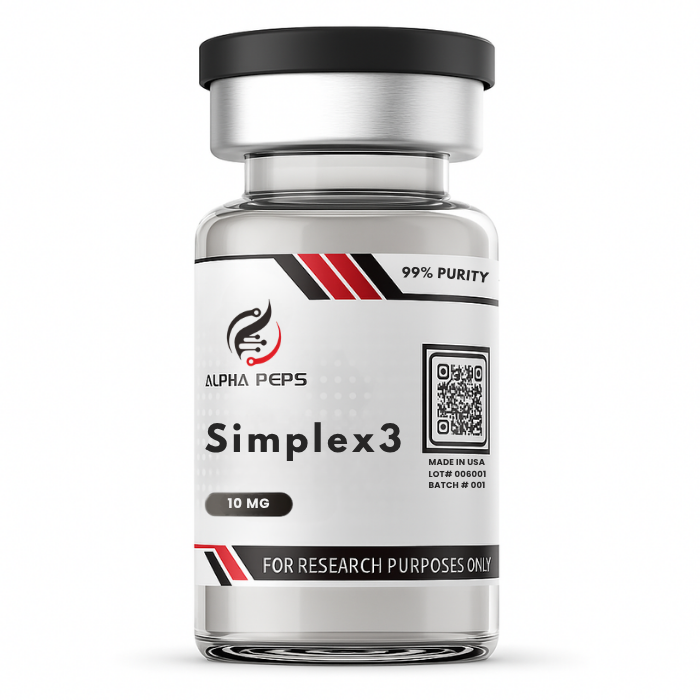

Simplex3 10MG
$157.00
The world’s first quad-receptor research peptide. GIP + GLP-1 + Glucagon + Ghrelin — a retatrutide-class GIP/GLP-1/Glucagon backbone with a proprietary ghrelin prokinetic mechanism appended via PEG4 spacer. C18 diacid lipidation at Lys17 for once-weekly half-life targeting. 99% purity HPLC verified. LCMS mass confirmed. Batch-specific COA with every order. Patent pending. For laboratory research use only.
Simplex3 (10mg) — Quad-Receptor Research Overview
Simplex3 is a research-grade synthetic peptide representing the first quad-receptor agonist design in the GLP-class category. Where retatrutide pioneered the triple GIP/GLP-1/Glucagon receptor stack, Simplex3 appends a fourth mechanism — partial ghrelin receptor (GHS-R1a) agonism — to the same backbone via a PEG4 molecular spacer.
The 10mg vial is the entry format for researchers examining single-receptor contribution studies, dose-response profiling, or initial pharmacokinetic characterization of the quad-receptor mechanism. LOT 006001 / BATCH 001.
The Four-Receptor Stack
GLP-1 receptor activity (31%) — glucose-dependent insulin secretion, satiety signaling, glucagon suppression.
GIP receptor activity (24%) — enhanced glucose-dependent insulin response, energy partitioning, reduced lipid storage at adipose tissue.
Glucagon receptor activity (22%) — increased resting energy expenditure, hepatic glucose modulation, enhanced fat oxidation. The glucagon co-target distinguishes retatrutide-class research from tirzepatide-class.
Ghrelin receptor partial agonism (15%) — the novel fourth mechanism — GHS-R1a activation is the only known prokinetic mechanism that directly counteracts GLP-1-induced delayed gastric emptying. The root cause of nausea, vomiting, and gastroparesis in GLP-class research models is the gastric motility reduction that accompanies GLP-1 receptor activation. Ghrelin receptor partial agonism accelerates gastric emptying through the opposite pathway. Real-world data from SIMPLEX-G2 (same prokinetic mechanism at 7.5mg) documents appetite suppression with no GLP-class GI symptoms, validating the ghrelin prokinetic hypothesis prior to formal Simplex3 trials.
Structural Features
Simplex3 incorporates a proprietary ghrelin fragment (Gly-Ser-Dap(N-octanoyl)-Phe-NH₂) appended to a retatrutide-derived GIP/GLP-1/Glucagon backbone via PEG4 spacer. C18 diacid lipidation at Lys17 enables albumin binding, targeting a once-weekly half-life consistent with the retatrutide class. Novel composition of matter. Patent pending.
Analytical Verification — LOT 006001 / BATCH 001
Every Simplex3 vial is purified via reverse-phase HPLC, characterized by LCMS, and independently tested for endotoxins before leaving the facility. Batch-specific COA ships with every vial.
- Purity (HPLC): ≥ 99.0% — Pass
- Net weight: 10mg ± 0.3% — Pass
- Mass confirmation (LCMS): match within 0.5 Da — Pass
- Endotoxin: < 5 EU/kg — Pass
- Bioburden: < 10 CFU/vial — Pass
- Amino acid analysis: sequence verified — Pass
- Residual solvents: < ICH limits — Pass
- Water content (KF): < 3.0% w/w — Pass
What Every Vial Ships With
- Batch-specific Certificate of Analysis
- LCMS chromatogram and mass confirmation
- Endotoxin and residual solvent reports
- Reconstitution protocol and handling guide
- Cold-chain compatible packaging
Research Context
No controlled human clinical trial data exists for Simplex3. The ghrelin prokinetic mechanism is supported by peer-reviewed preclinical and clinical research on GHS-R1a agonists as prokinetic agents, and by real-world observational data from SIMPLEX-G2 at 7.5mg. The GIP/GLP-1/Glucagon backbone is derived from published retatrutide structural data (Eli Lilly, LY3437943). Patent pending.
Not approved by the FDA for human or veterinary therapeutic use. Sold for laboratory research purposes only.
Read the full Simplex3 research overview and science documentation →
For laboratory research use only. Not intended for human or veterinary consumption. Not FDA approved for any indication.
Related products