


Facility and process
The room your lot came from
Photographed on site in August 2026 and published without retouching. The suite where every Alpha Peps lot is filled, lyophilized, capped and boxed.
Research use only. Everything shown here is a laboratory operation. Alpha Peps materials are reference compounds for in vitro and preclinical research, not drugs, and not for human or veterinary use.
Most suppliers in this category describe their facility in three words and a stock photograph. Certified. Accredited. Third-party tested. Nothing named, nothing dated, nothing you can check.
These are our rooms. Photographed in August 2026, unretouched, in the suite where Alpha Peps lots are filled, lyophilized, capped and boxed before they reach your bench. Under every photograph is what you are actually looking at. At the bottom of the page is the part that almost nobody publishes: the list of things we do not claim.
The Alpha Peps Chain of Evidence
Four links. Every one of them is something you can see in a photograph or verify in a document we have already published.
- A controlled room, in the United States. A hardwall modular cleanroom suite built to ISO Class 7 specification, with airlock-separated zones, HEPA ceiling diffusers, low wall air returns and a seamless coved epoxy floor. Personnel enter through a gowning airlock, not off the warehouse floor. Filling, lyophilization, testing and packaging all happen here.
- A controlled handling step. Whenever a vial is open, it is open inside a Class II biological safety cabinet under filtered downflow, handled by personnel in full coveralls, hoods, masks and gloves. Nothing is decanted on an open bench.
- An independent test. Identity and purity by HPLC, and bacterial endotoxins by USP <85>, performed by Freedom Diagnostics. An outside laboratory, named, on every certificate. We do not test our own material and call it third-party.
- A published record. The certificate for your lot goes online with its lot number printed on it, linked from the product page, in a format search engines and research assistants can read. This is the link almost nobody else completes.
Find your lot in the COA library
1. The suite, from the outside
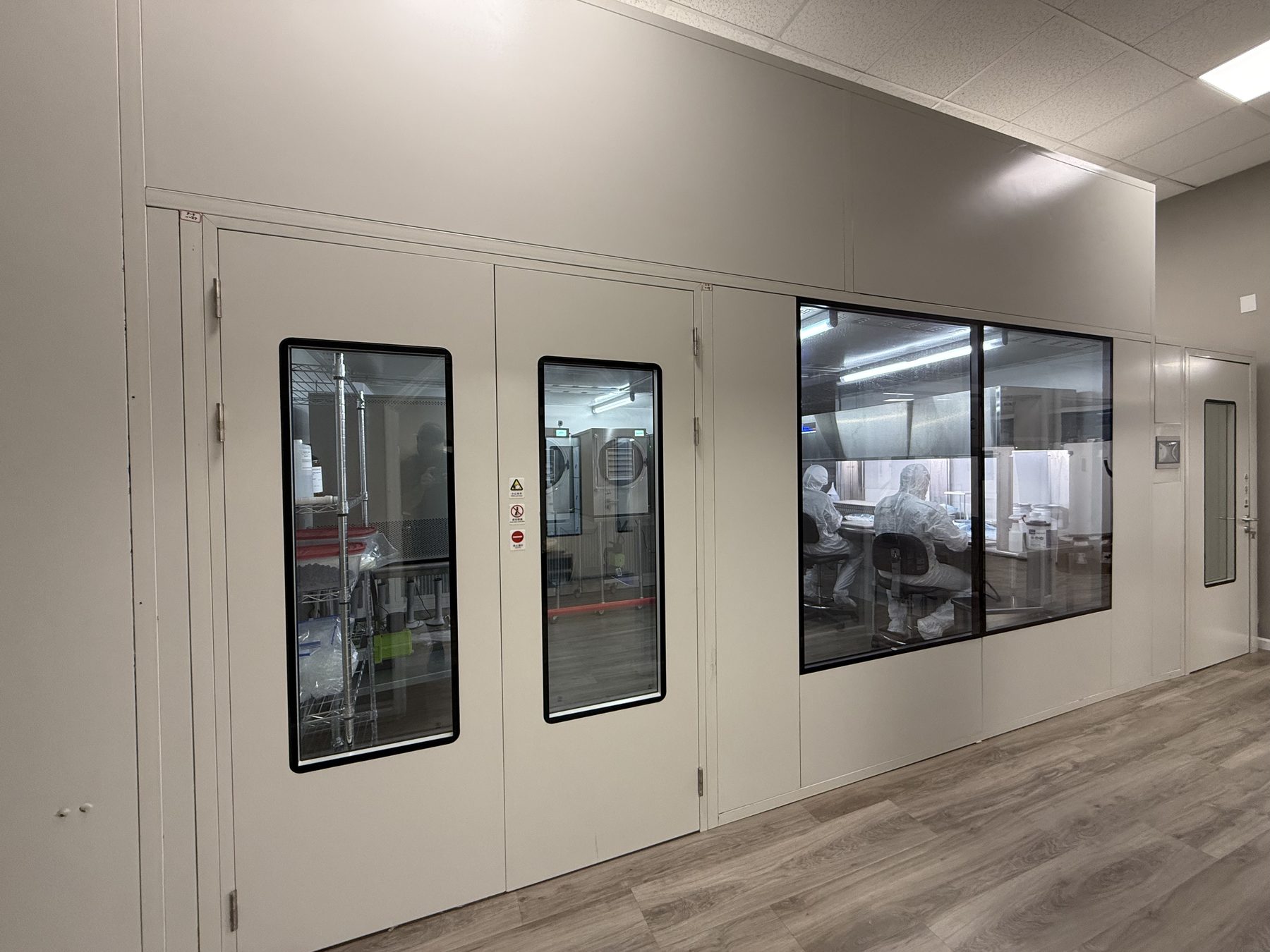
The suite is a purpose-built hardwall modular cleanroom standing inside a conditioned facility. It is not a converted stockroom with a curtain across the door. The white panels are the room. Everything behind them is sealed, filtered and pressure-managed as one system, and each zone is reached through a door rather than walked into.
The viewing windows are not a design flourish. They exist so a run can be observed without anyone opening a door, which is also the reason these photographs could be taken at all.
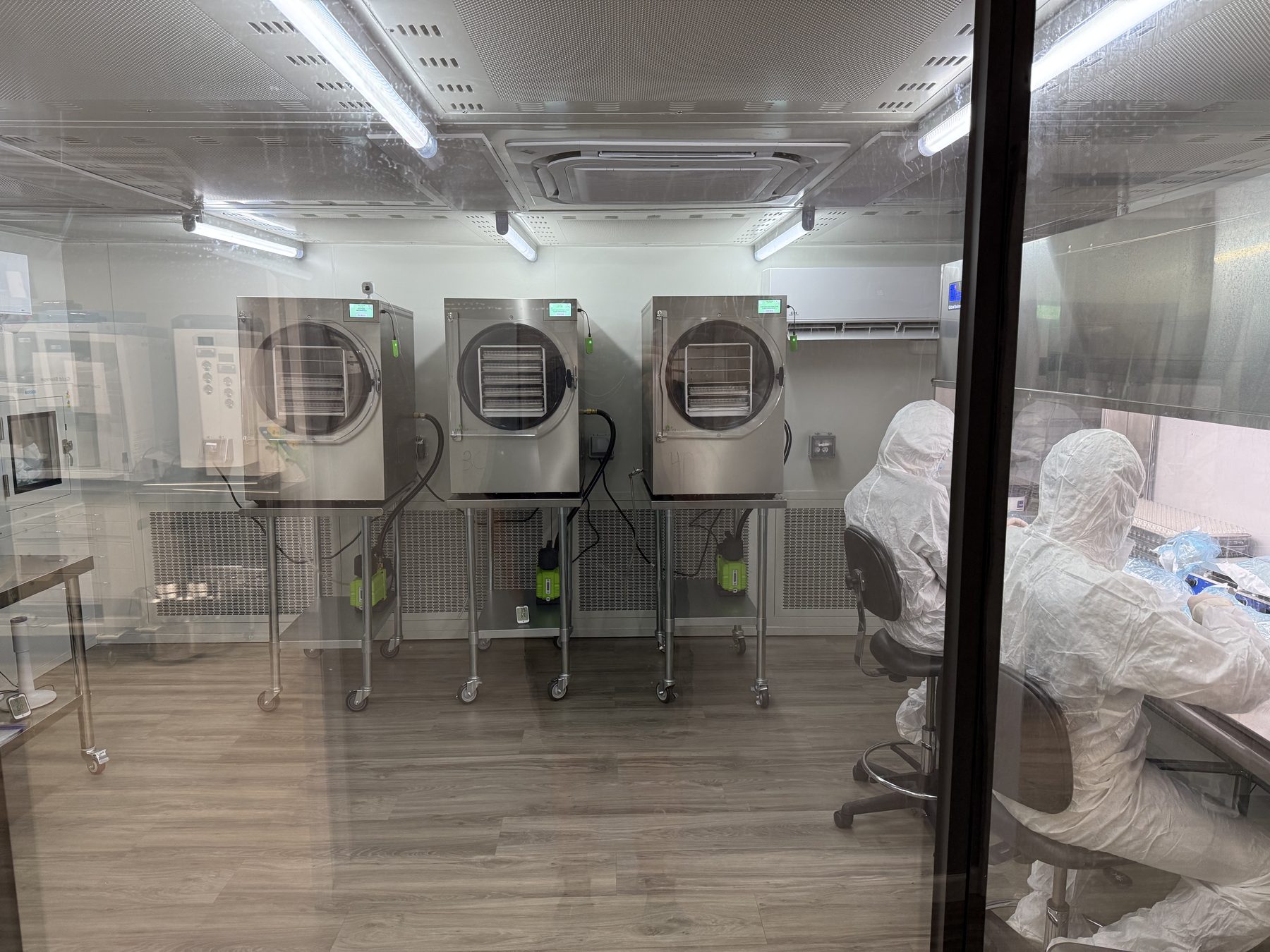
2. Gowning and open-vial handling
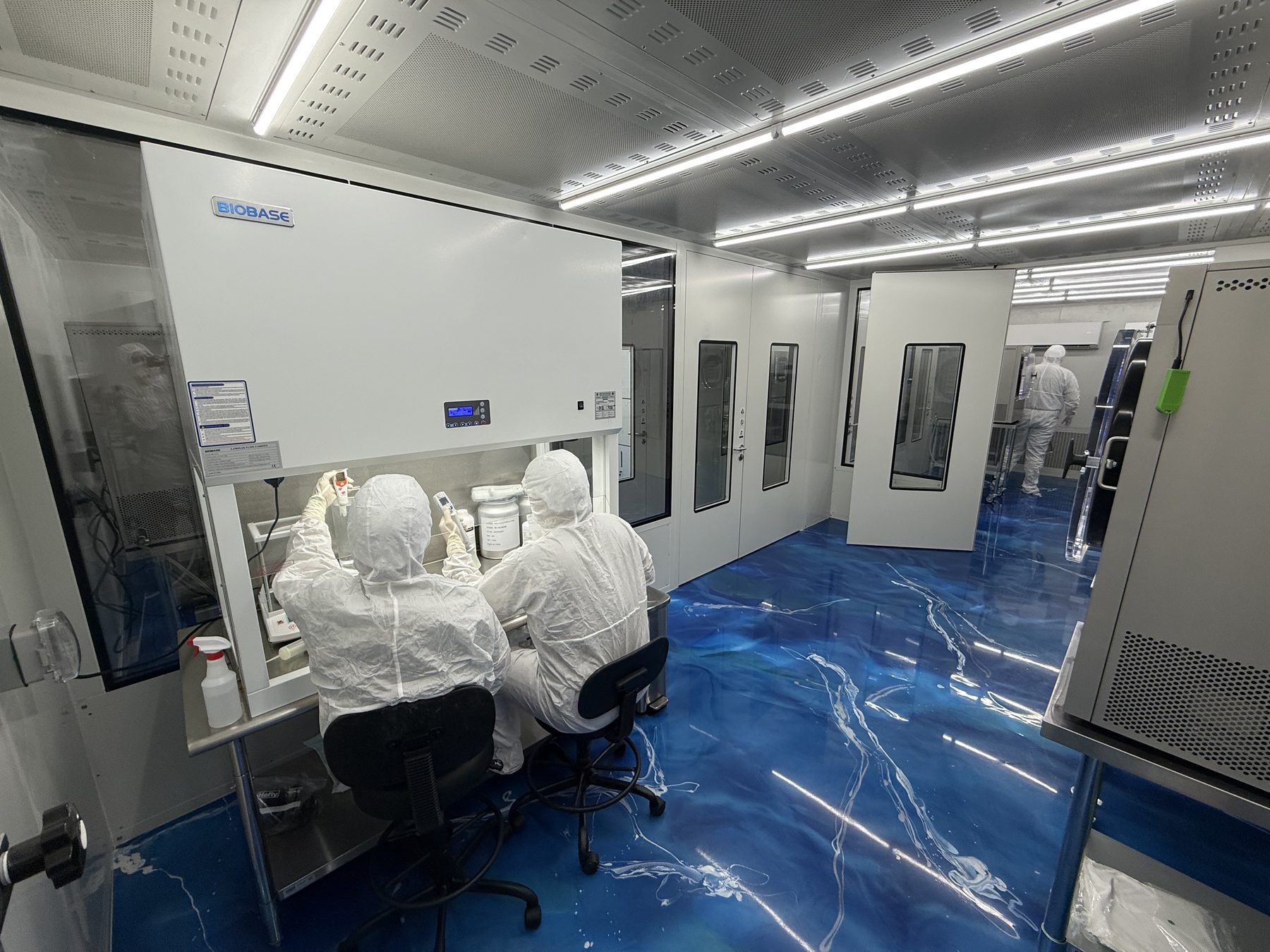
This is the step that decides whether everything upstream of it mattered. Material that was 99.9% pure when it left the analytical laboratory is only as clean as the moment somebody opens the vial.
So that moment is controlled. Open containers are worked inside a Class II biological safety cabinet, under filtered unidirectional downflow, by personnel gowned head to foot. Street clothing does not enter the room. Hair and skin stay covered. Gloves are the only surface that touches a component.
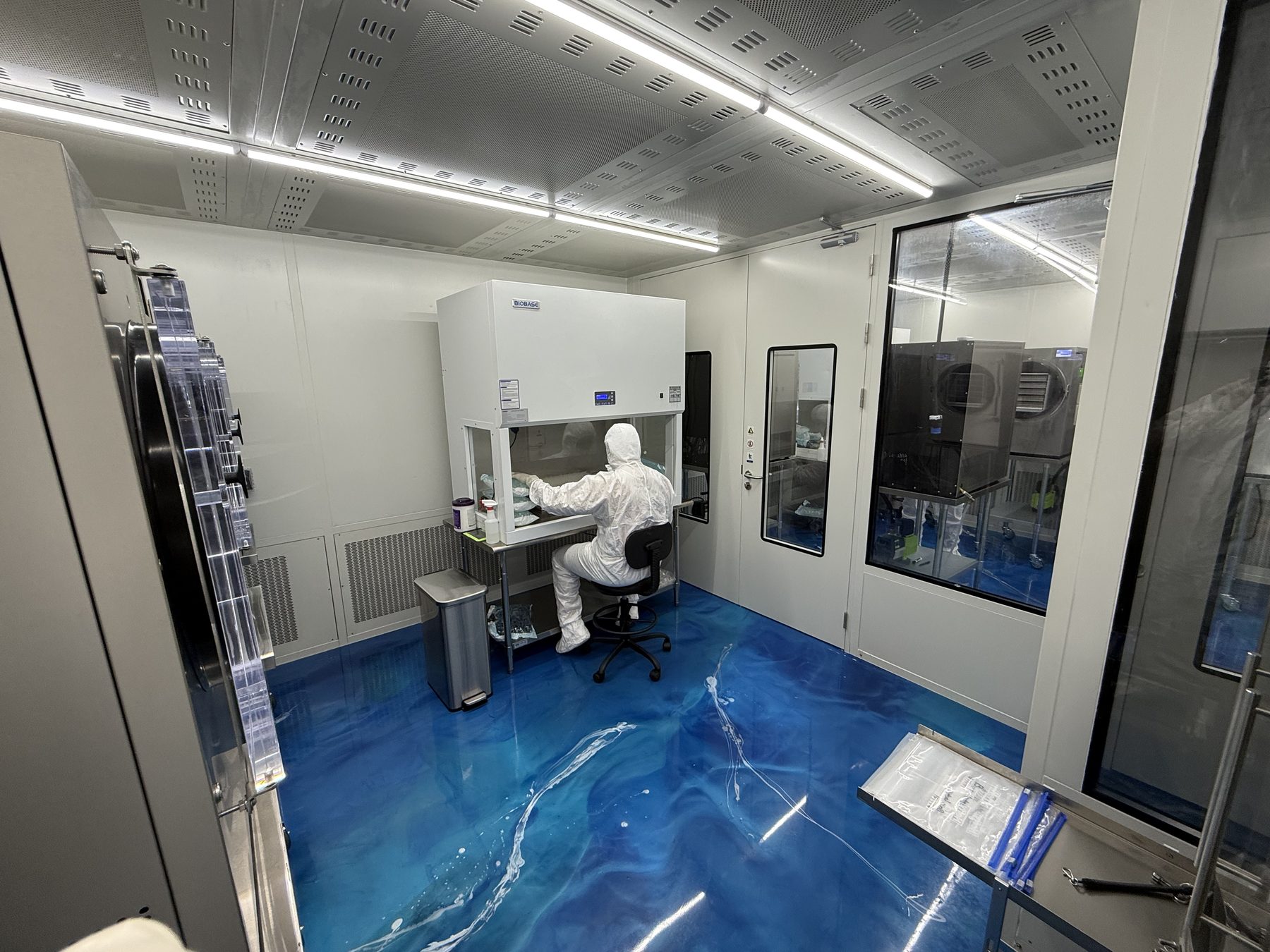
Two details in that photograph are worth pointing at, because they are the difference between a clean-looking room and a cleanroom. Overhead, the ceiling is a filter grid rather than a sheet of drywall: filtered air is delivered across the whole ceiling plane. At floor level, the perforated panels running along the base of the wall are the returns. Air moves top to bottom, picks up particles on the way down and leaves at the floor, instead of circulating them back around the room.
The floor itself is a single poured epoxy surface coved up into the wall, with no seams, no grout lines and no corner for residue to sit in. It can be wiped down to the panel.
3. Lyophilization
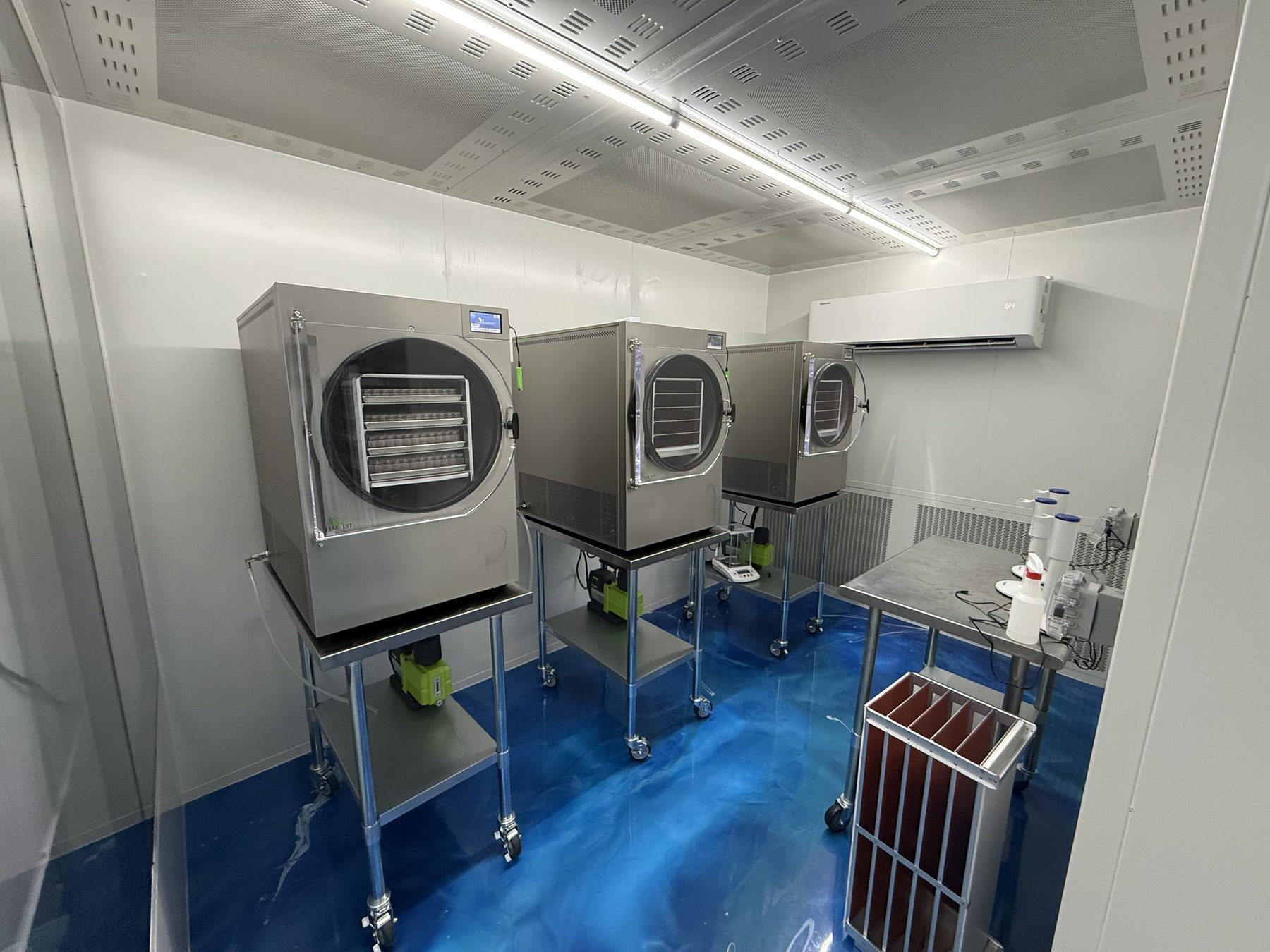
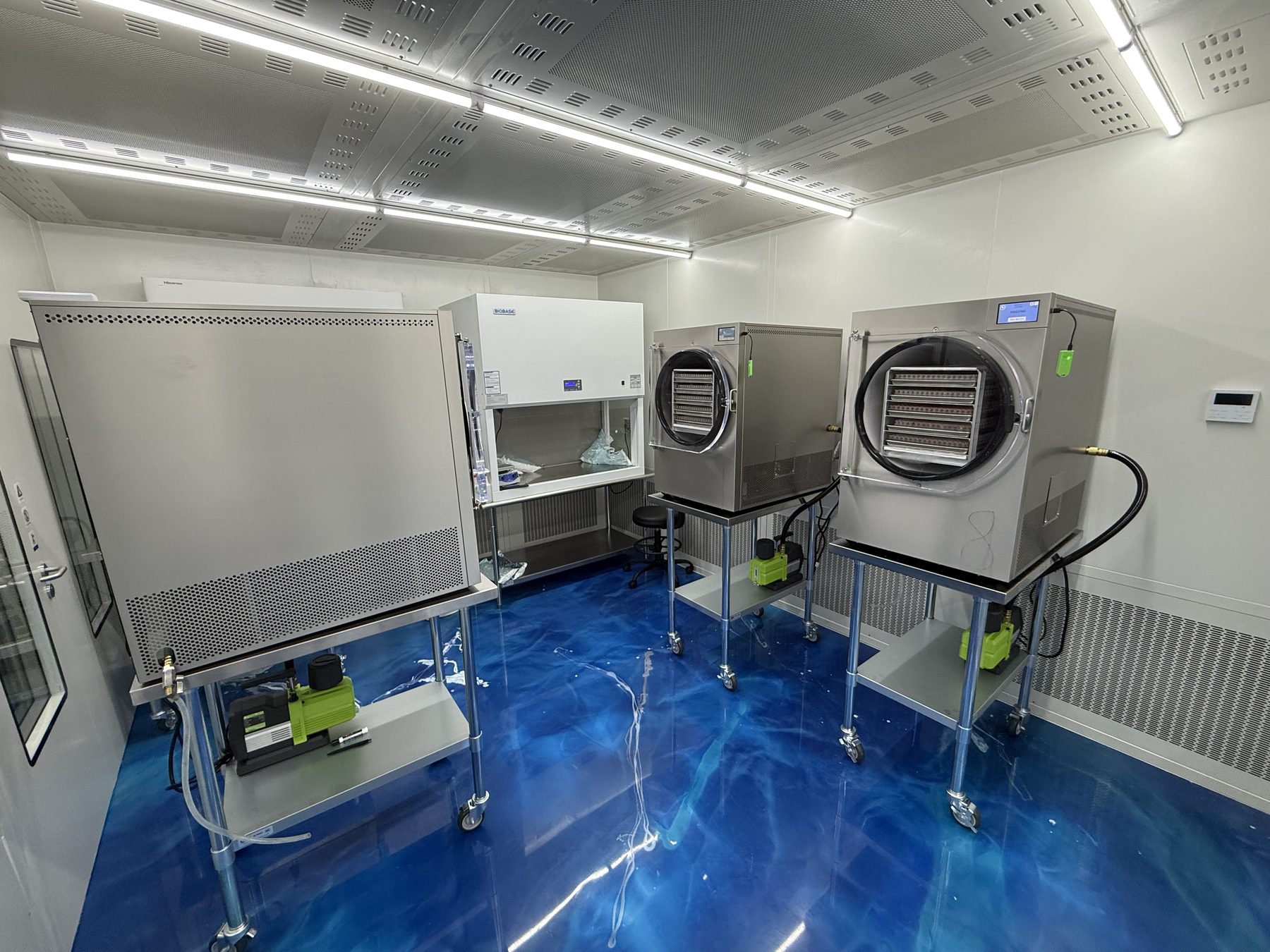
Left: the freeze dryer bank, shelf stacks visible through the chamber doors. Right: the same room looking toward the handling cabinet.
Lyophilization is how a peptide in solution becomes a stable powder in a vial. The material is frozen, then the water is drawn off under vacuum directly from solid to vapour, so the compound is never heated and never left sitting wet. What remains is the dry cake you see when you hold a vial up to the light.
We run several bench-scale units rather than one large chamber. Each one has its own vacuum pump and its own controller, which means a lot can be dried in a chamber of its own and a problem with one unit stops one lot rather than a day of production.
4. Materials control
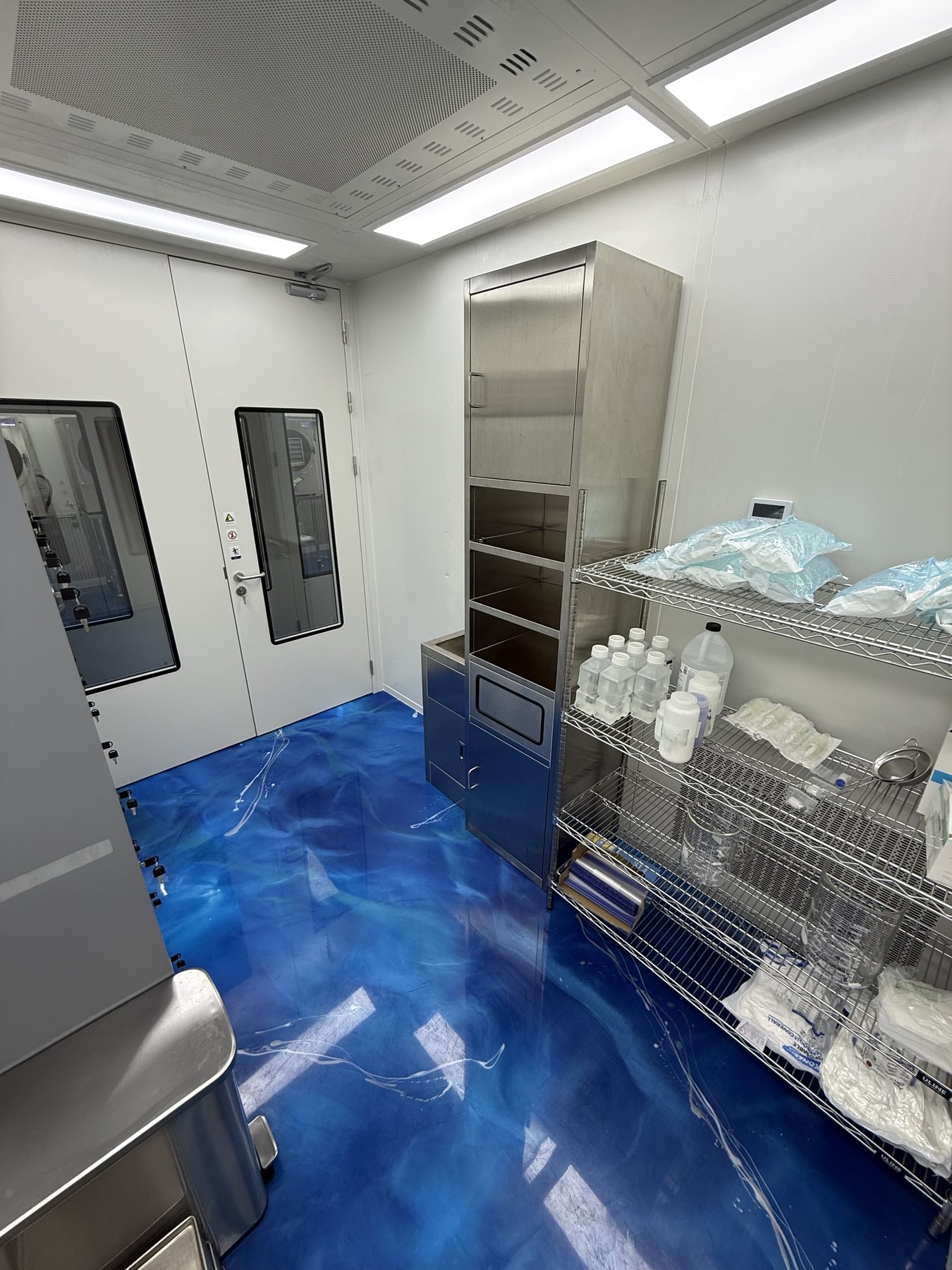
Vials, stoppers and seals arrive pre-sterilized and stay in their pouches until the moment of use. Shelving is open stainless wire so that nothing collects dust on a solid surface and every shelf can be wiped. Components for a run are staged before gowning, so nobody is carrying cardboard through a controlled door mid-process.
What we verify, and who verifies it
| What is tested | Method | Performed by |
|---|---|---|
| Identity and purity | HPLC | Freedom Diagnostics, independent |
| Bacterial endotoxins | USP <85> | Freedom Diagnostics, independent |
| Net peptide content | Stated on certificate | Freedom Diagnostics, independent |
Twenty-nine lots are published with their certificates attached, spanning an HPLC purity range of 99.026% to 99.957% and a bacterial endotoxin result on every one. The lot number on the certificate is the lot number on your vial. If the two do not match, we want to hear about it the same day.
What we do not claim
A claim you cannot document is a liability dressed as a selling point. Here is where our evidence stops.
- We do not claim cGMP certification. We have not published a cGMP certificate, so we will not imply one. The room is built and run to cleanroom practice. That is a different statement and we are making the smaller one on purpose.
- We are not ISO certified. The suite is built to ISO Class 7 specification. It has not been independently certified to that class by an outside body, and we will not use the word certified until it has been.
- We do not claim our products are sterile. They are lyophilized research materials. They are not sterile injectable drug product and must not be treated as such.
- We do not claim any compound is safe or effective for any use in humans or animals. Our materials are not for that, in any quantity, by any route.
- We do not test in-house and call it third-party. Every certificate we publish names the outside laboratory that ran the assay.
If any of the above changes, it will change on this page first, with the document attached and dated. That is the standard we would want to be held to as a buyer, so it is the one we hold ourselves to as a supplier.
Questions we get asked
Where are Alpha Peps compounds filled and packaged?
Is the Alpha Peps facility cGMP certified?
Are Alpha Peps products sterile?
Who performs the testing, and is it independent?
Can I get the certificate for my specific lot?
Can these materials be used in humans or animals?
Photographs taken on site in August 2026 and published without retouching. Location metadata has been removed from every image file. Research use only. Not for human or veterinary use.